Ch. 6 & Ch. 7: Applications of \(t\)-tests
STAT 218 - Week 6, Lecture 4 Lab 4
What Have We Learned So Far?
A Snapshot
- Descriptive Statistics describes and summarizes data.
- Includes understanding
- distribution shape (skewed, normal, etc.),
- central tendency (mean, median, mode), and
- spread (variance, standard deviation, range).
- Includes understanding
- Inferential Statistics makes predictions and draws conclusions about populations based on sample data.
- We saw different types of t-tests:
- One sample t-test: compares a sample mean to a known or hypothesized population mean.
- Independent samples t-test: compares means of two independent groups.
- We saw different types of t-tests:
Estimation and Hypothesis Testing
We learned that we can estimate the unknown parameters in two ways:
Point estimation: A single value calculated from the sample (e.g., \(\bar{y}\))
Confidence Intervals: A range of values within which the parameter is expected to fall, with a certain degree of confidence.(e.g., 95% CI, 90% CI)
We also learned that we can use hypothesis testing to test for a specific value(s) of the parameter.
- e.g., \(H_0: \mu = 76\) cm & \(H_A: \mu \neq 76\) cm (Two-tailed test)
- \(H_0: \mu_1 - \mu_2 = 0\) cm \(H_A: \mu_1 > \mu_2\) (One-tailed test)
Hypothesis Testing Steps
Introduction
Important
We can summarize hypothesis testing in five steps:
- Construct the Hypotheses of \(H_0\) and \(H_A\)
- Check the validity conditions/assumptions (We will see this today)
- Compute test statistic and find the p-value (Interpreting R Output)
- Draw conclusion.
Assumptions - Validity Conditions
- It is always important to check first whether the conditions are reasonable in a given case.
- Here is the list of conditions that we should be aware of for \(t\)-tests.
1) Random Sampling: the data can be regarded as coming from independently chosen random sample(s),
2) Independence of Observations: the observations should be independent, and
3) Normal Distribution: Many of the methods depend on the data being from a population that has a normal distribution.
- REMEMBER! If sample size is large, then condition (3) is less important (Central Limit Theorem).
Normality Assumption - I
If the only source of information is the data at hand, then normality can be roughly checked.
- Unfortunately, for a small or moderate sample size, this check is fairly rudimentary.
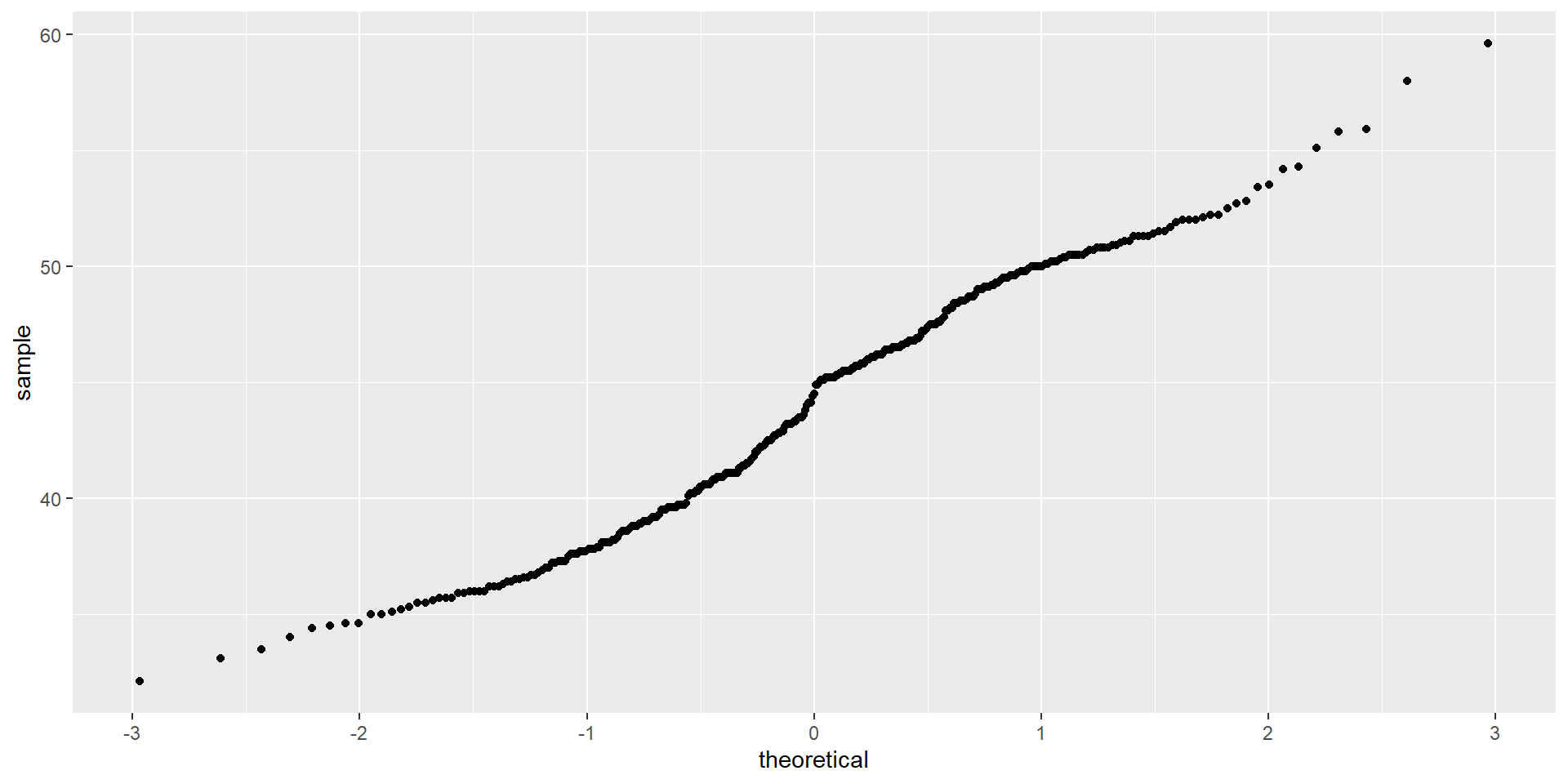
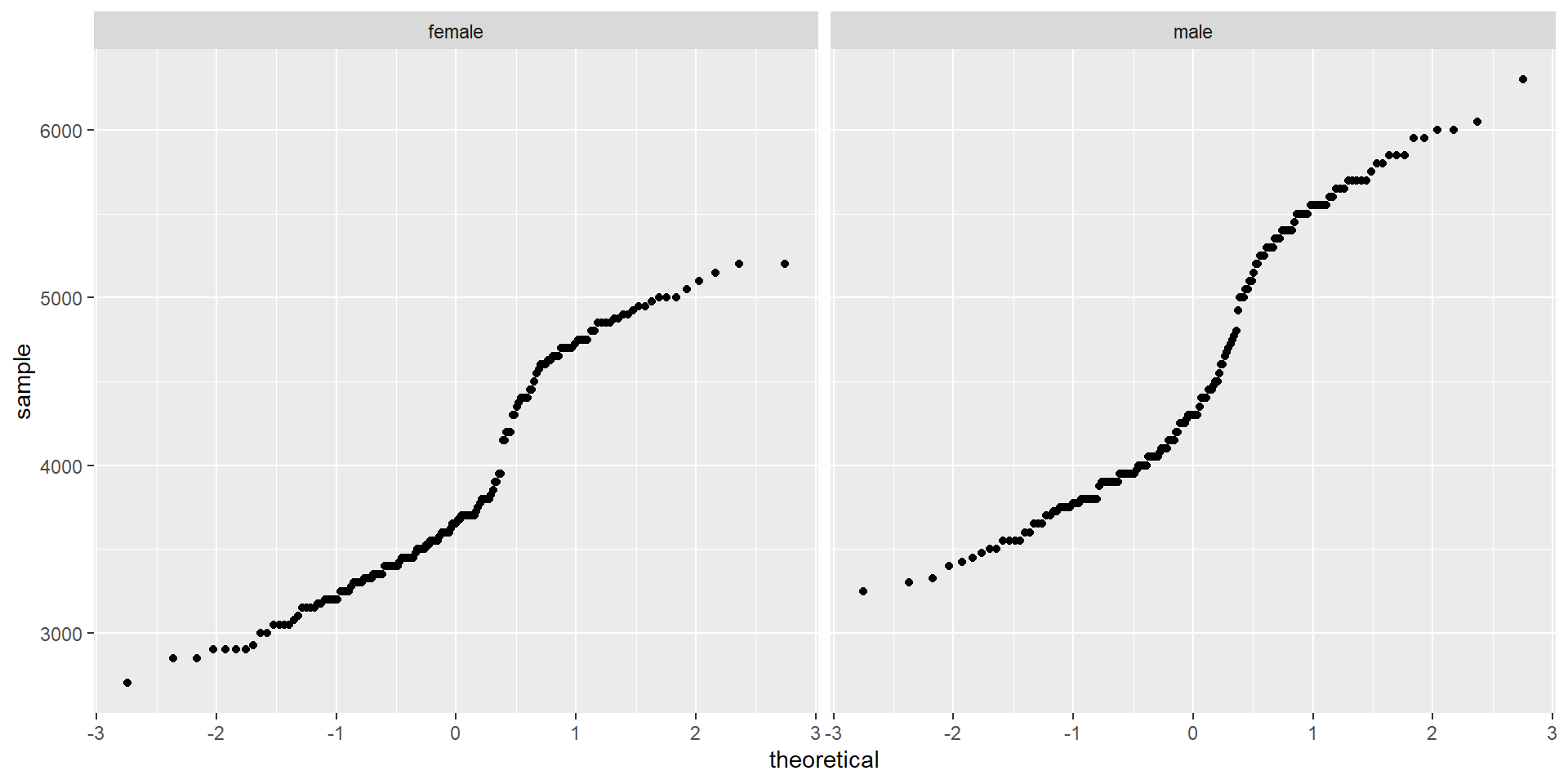
- If the sample is large, then the visual plots (histogram and normal quantile plot) give us good information about the population shape;
- However, if \(n\) is large, the requirement of normality is less important anyway due to the Central Limit Theorem.
In any case, a rudimentary check is better than none, and every data analysis should begin with inspection of a graph of the data, with special attention to any observations that lie very far from the center of the distribution.
Normality Assumption - II
We check assumptions/validity conditions before conducting any statistical analysis. To check normality assumption, we need to first check sample size.
\(1^{st}\) option - small samples: Check the \(p\)-value of Shapiro Wilk test. It is best used with a sample size less than 50 (Shapiro & Wilk 1965; Uttley,2019).
\(2^{nd}\) option - large samples: Check the visual plots (e.g., histogram, normal quantile plot) if your sample size is more than 50.
Today we will have large samples so we will learn Shapiro-Wilk next week.
One Sample \(t\)-test
To-do List Before Start
- Download the worksheet and from Canvas (Lab Assignment 4).
- Save them to your STAT 218 folder.
- Assign your roles.
Project Manager:
- Follow the slides and give directions to the coder and note taker.
- Facilitate communication within the group and with the instructor.
Note Taker:
- Take notes on key findings, insights, and interpretations derived from the data and analyses.
Coder:
- Lead the coding efforts, writing and managing the R scripts.
- Ensure code quality, functionality, and documentation standards are met.
Introduction
- In one sample \(t\) tests, data collected from one sample and compares the mean score with a test value.
- Test value can be
- reported previously in the literature; or
- found by calculating level of chance.
- Test value can be
Introduction - II
- To begin with, we need
inferpackage to conduct t tests. - Let’s run the code chunk in our lab assignment file and load
inferpackage by usinginstall.packages()function.
Introduction - III
After loading that package, let’s run library functions and load the data sets that we will use today.
Example of a Case:
Imagine that you are a biologist studying penguins, particularly their bill lengths. You hypothesize that the average bill length of penguins is 40 mm and you collect a random sample of 344 penguins, measure and record their bill length in mm.
Perform a one sample \(t\)-test to investigate whether the bill length of the penguins differs from the test value of 40 mm.
Instructions
Open the assignment file and answer the following questions.
Question 1. What is the research question of this study?
Type your answer in the assignment file.
Question 2. What type of variable is used in this study?
Type your answer in the assignment file.
Question 3. Checking the Normality Assumption
- Check your sample size first!
- \(n\) > 50, so we can check visual plots.
- Direction: Please create a histogram to check the normality.
Question 3. Quantile Plot
Question 4. Interpreting the Output
# A tibble: 1 × 7
  statistic  t_df  p_value alternative estimate lower_ci upper_ci
      <dbl> <dbl>    <dbl> <chr>          <dbl>    <dbl>    <dbl>
1      13.3   341 9.58e-33 two.sided       43.9     43.3     44.5
Conclusion: Type your hypothesis testing conclusion to your assignment file!
Confidence Interval: Type your confidence interval statement to your assignment file!
Independent Samples \(t\)-test
Example of a Case:
Now, you’re curious about the difference in the body mass of penguins based on their sex. You hypothesize that body mass varies between different sexes. To test your hypothesis, you collect a random sample of 344 penguins, measure their body mass, and record their sex.
Perform an independent samples \(t\)-test to investigate whether the body mass of penguins differs between different sexes.
Instructions
Continue with the assignment file and answer the following questions.
Question 1. What is the research question of this study?
Type your answer in the assignment file.
Question 2. What type of variable is used in this study?
Type your answer in the assignment file.
Question 3. Checking the Normality Assumption
- Check your sample size first!
- \(n\) > 50, so we can check visual plots.
Question 3. Quantile Plots
Question 4. Interpreting the Output
t_test(x = penguins,
       formula = body_mass_g ~ sex,
       order = c("male", "female"),
       alternative = "two-sided",
       conf_level = 0.90)
# A tibble: 1 × 7
statistic t_df p_value alternative estimate lower_ci upper_ci
<dbl> <dbl> <dbl> <chr> <dbl> <dbl> <dbl>
1 8.55 324. 4.79e-16 two.sided 683. 552. 815.Conclusion: Type your hypothesis testing conclusion to your assignment file!
Confidence Interval: Type your confidence interval statement to your assignment file!