Paired Sample \(t\)-test
STAT 218 - Week 7, Lecture 4 Lab 4
Let’s Remember Hypothesis Testing Steps
Revising the Steps of Hypothesis Testing
Important
- Construct the Hypotheses of \(H_0\) and \(H_A\)
- Check the assumptions
- Compute test statistic and find the p-value (Interpreting R Output)
- Draw conclusion.
Paired Samples \(t\)-test
To-Do List Before Start
Download the assignment and dataset from Canvas.
- Mac Users: Downloading a
.csvfile from Canvas can be tricky. Try opening it in a new tab to download.
- Windows Users: Congratulations, you are privileged and blessed! Your
.csvfile should download without a fight (hopefully).
- Important: Even if you manage to download it, please do not open it on your computer. Mac sometimes automatically changes the file extension (yes, really!), which makes it harder to import with this lab’s code.
- Mac Users: Downloading a
Save both files to your
STAT 218folder (VERY IMPORTANT). Otherwise, you won’t be able to import the dataset.Ensure your assignment and dataset are in the same folder, with file extensions
.qmdand.csv.Follow the instructions on this slideshow to complete the assignment.
Introduction
Let’s use library functions and load the data sets that we will use today.
IMPORTANT!: If you don’t see stream_data in your Environment Pane, this means that your dataset and quarto file are not in the same folder!
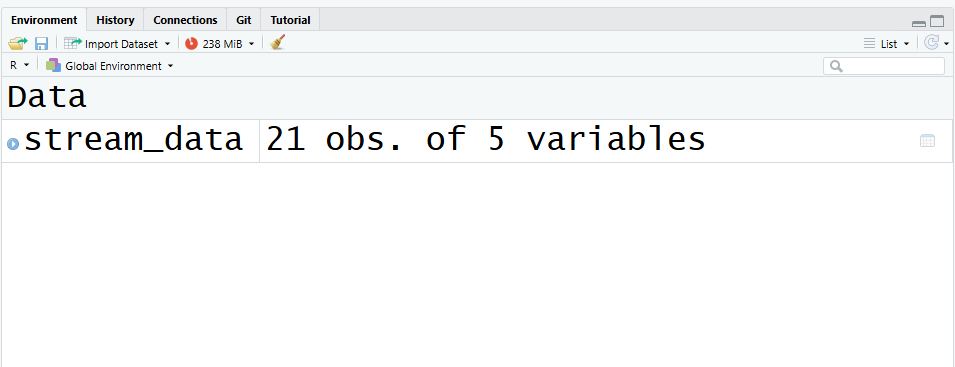
OR…
You may have downloaded stream.csv multiple times, so its name could look like stream (2)(1).csv.
Check the file name, correct it if necessary, and try again. Remember, R is very stubborn—it won’t read the data if the name doesn’t match exactly what you typed in your code.
Example of a Case: Pollutants in a stream may accumulate or attenuate as water flows down the stream. In a study to monitor the accumulation and attenuation of fecal contamination in a stream running through cattle rangeland, monthly water specimens were collected at two locations along the stream over a period of 21 months.
The data set stream the total coliform count (MPN/100ml) for a water specimen.
Perform a paired sample \(t\)-test to assess whether the mean total coliform count is consistent across the two locations.
Assumptions - Verification of Conditions
- It is always important to check first whether the conditions are reasonable in a given case.
- Here is the list of assumptions that we should be aware of for \(t\)-tests.
1) Random Sampling: the data can be regarded as coming from independently chosen random sample(s),
2) Independence of Observations: the observations should be independent within each sample, and
3) Normal Distribution: Many of the methods depend on the data being from a population that has a normal distribution.
- REMEMBER! If sample size is large, then condition (3) is less important (Central Limit Theorem).
Checking the Normality Assumption
Check your sample size first!
- \(n\) < 50, so we should check Shapiro-Wilk test.
Shapiro–Wilk Test is a statistical method that provides a numerical assessment of evidence for certain types of nonnormality in data.
- The procedure’s mechanics are complex, but statistical software packages simplify the testing process. Output and Interpretation:
The output of the Shapiro–Wilk test includes a P-value. Interpretation:
- P-value < 0.001: Very strong evidence for nonnormality.
- P-value < 0.01: Strong evidence for nonnormality.
- P-value < 0.05: Moderate evidence for nonnormality.
- P-value < 0.10: Mild or weak evidence for nonnormality.
- This output is from a calculation of Shapiro-Wilk test. We generally use Shapiro-Wilk test for relatively smaller sample size because visuals can be misleading in smaller sample sizes. Please interpret Shapiro-Wilk \(p\)-value.
Shapiro-Wilk normality test
data: stream$Difference W = 0.9641, p-value = 0.6022
t_test vs. t.test
If you notice, we used
t_test()function last week while conducting independent samples t-test by usinginferpackage.Today, we will use
t.test()which is available default in R (And some BIO courses use this too).
Interpreting the Output - Question 4.2
    Paired t-test

data:  stream$upstream and stream$downstream
t = 4.6092, df = 20, p-value = 0.0001697
alternative hypothesis: true mean difference is not equal to 0
95 percent confidence interval:
  603.7724 1602.0562
sample estimates:
mean difference
       1102.914
Interpreting the Output - Question 4.3
Question 4.4
Compare and contrast how the codes in Question 4.2 and Question 4.3 work. Comment on the
- p-value,
- test statistic, and
- confidence interval.
If they produce the same results, explain what the two codes did differently.
Question 4.5
Conclusion: Type your conclusion statement to your assignment!
Confidence Interval: Type your confidence interval statement to your assignment!